
Format
Takarir
Saduran dari artikel majalah The Wire
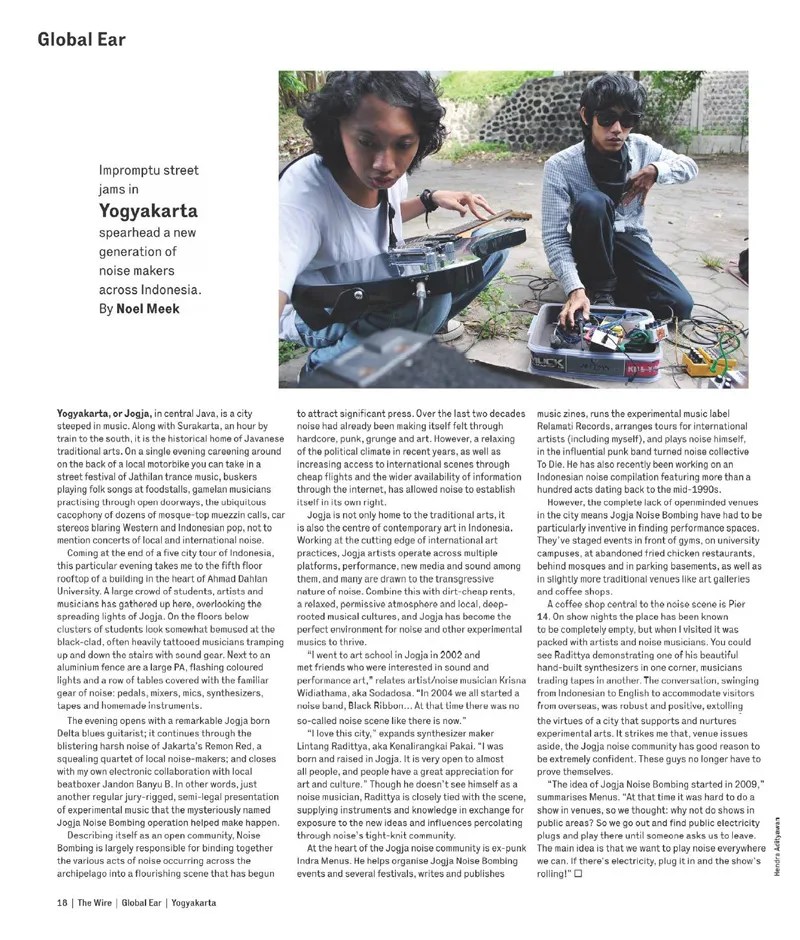
Yogyakarta, or Jogja, in central Java, is a city steeped in music. Along with Surakarta, an hour train to the south, it is the historical home of Javanese traditional arts. On a single evening careening around on the back of a local motorbike you can take in a street festival of Jathilan trance music, buskers playing folk songs at foodstalls, gamelan musicians practising through open doorways, the ubiquitous cacophony of dozens of mosque-top muezzin calls, car stereos blaring Western and Indonesian pop, not to mention concerts of local and international noise.
Coming at the end of a five city tour of Indonesia, this particular evening takes me to the fifth floor rooftop of a building in the heart of Ahmad Dahlan University. A Large crowd of students, artists and musicians has gathered up here, overlooking the spreading lights of Jogja. On the floors below clusters of students look somewhat bemused at the black-clad, often heavily tattooed musicians tramping up and down the stairs with sound gear. Next to an aluminium fence are a large PA, flashing coloured lights and a row of tables covered with the familiar gear of noise: pedals, mixers, mics, synthesizers, tapes and homemade instruments.
The evening opens with a remarkable Jogja born Delta blues guitarist; it continues through the blistering harsh noise of Jakarta’s Remon Red, a squealing quartet of local noise-makers; and closes with my own electronic collaboration with local beatboxer Jandon Banyu B. In other words, just another regular jury-rigged, semi-legal presentation of experimental music that the mysteriously named Jogja Noise Bombing operation helped make happen.
Describing itself as an open community, Noise Bombing is largely responsible for binding together the various acts of noise occurring across the archipelago into a flourishing scene that has begun to attract significant press. Over the last two decades noise had already been making itself felt through hardcore, punk, grunge, and art. However, a relaxing of the political climate in recent years, as well as increasing access to international scenes through cheap flights and the wider availability of information through the internet, has allowed noise to establish itself in its own right.
Jogja is not only home to the traditional arts, it is also the centre of contemporary art in Indonesia. Working at the cutting edge of international art practices, Jogja artists operate across multiple platforms, performance, new media and sound among them, and many are drawn to the transgressive nature of noise. Combine this with dirt-cheap rents, a relaxed, permissive atmosphere and local, deep-rooted musical cultures, and Jogja has become the perfect environment for noise and other experimental music to thrive.
“I went to art school in Jogja in 2002 and met friends who were interested in sound and performance art,” relates artist/noise musician Krisna Widiathama, aka Sodadosa. “In 2004 we all started a noise band, Black Ribbon… at that time there was no so-called noise scene like there is now.”
“I love this city,” expands synthesizer maker Lintang Radittya, aka Kenalirangkai Pakai. “I was born and raised in Jogja. It is very open to almost all people, and people have a great appreciation for art and culture.” Though he doesn’t see himself as a noise musician, Radittya is closely tied with the scene, supplying instruments and knowledge in exchange for exposure to the new ideas and influences percolating through noise’s tight-knit community.
At the heart of the Jogja noise community is ex-punk Indra Menus. He helps organise Jogja Noise Bombing events and several festivals, writes and publishes music zines, runs the experimental music label Relamati Records, arranges tours for international artists (including myself), and plays noise himself, in the influential punk band turned noise collective To Die. He has also recently been working on an Indonesian noise compilation featuring more than a hundred acts dating back to mid-1990s.
However, the complete lack of openminded venues in the city means Jogja Noise Bombing have had to be particularly inventive in finding performance spaces. They’ve staged events in front of gyms, on university campuses, at abandoned fried chicken restaurants, behind mosques and in parking basements, as well as in slightly more traditional venues like art galleries and coffee shops.
A coffee shop central to the noise scene is Pier 14. On show nights the place has been known to be completely empty, but when I visited it was packed with artists and noise musicians. You could see Radittya demonstrating one of his beautiful hand-built synthesizers in one corner, musicians trading tapes in another. The conversation, swinging from Indonesian to English to accommodate visitors from overseas, was robust and positive, extolling the virtues of a city that supports and nurtures experimental arts. It strikes me that, venue issues aside, the Jogja noise community has good reason to be extremely confident. These guys no longer have to prove themselves.
“The idea of Jogja Noise Bombing started in 2009,” summaries Menus. “At that time it was hard to do a show in venues, so we thought: why not do shows in public areas? So we go out and find public electricity plugs and play there until someone asks us to leave. The main idea is that we want to play noise everywhere we can. If there’s electricity, plug it in and the show’s rolling!”
Tahun
Penulis
Bahasa
Penerbit
Tempat Penerbitan
Pranala
Media

 JOGJA SONIC INDEX