
Subjek Terkait
Format
Takarir
Saduran dari lembar kerja daring Septian Dwi Cahyo
PASCA MUSIK LELUHUR BARU/POST NEW SOURCE MUSIC
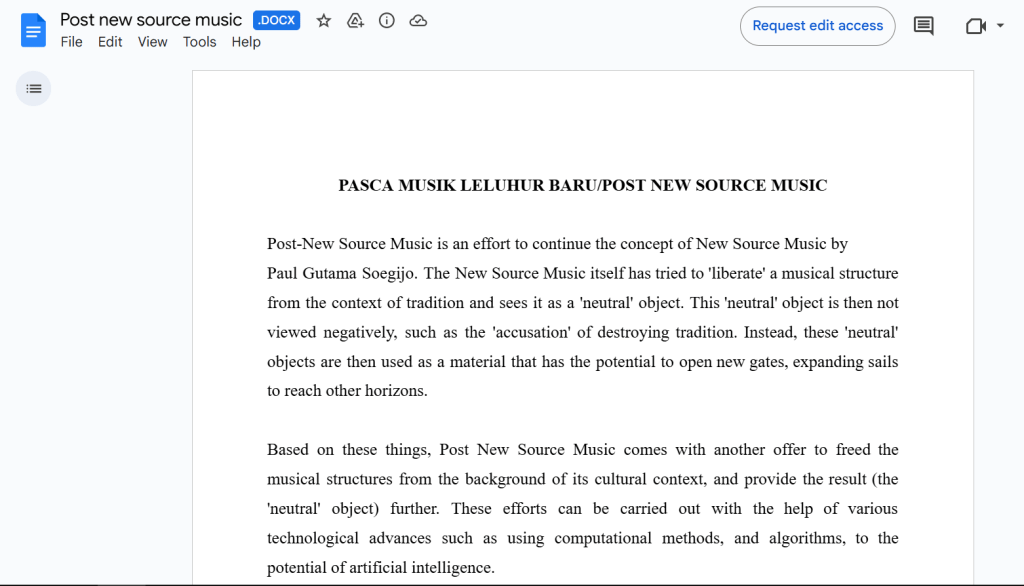
Post-New Source Music is an effort to continue the concept of New Source Music by
Paul Gutama Soegijo. The New Source Music itself has tried to ‘liberate’ a musical structure from the context of tradition and sees it as a ‘neutral’ object. This ‘neutral’ object is then not viewed negatively, such as the ‘accusation’ of destroying tradition. Instead, these ‘neutral’ objects are then used as a material that has the potential to open new gates, expanding sails to reach other horizons.Based on these things, Post New Source Music comes with another offer to freed the musical structures from the background of its cultural context, and provide the result (the ‘neutral’ object) further. These efforts can be carried out with the help of various technological advances such as using computational methods, and algorithms, to the potential of artificial intelligence.
We can see this kind of thing in Dion Nataraja’s work entitled ‘Pathetan Partiels’, which changes the function and context of saron with computational methods. He breaks it down into frequency materials that have been separated from the supporting context and become something new, which is ‘free’ from its history. I myself, with the help of computational technology, ‘freed’ the structural context of the gong and broke it, into something else with a new function, as an aspect of harmony (as in the work of Co[l]oto[mi]c[nal]).
It is not as simple as looking at tradition through the eyes of the French spectral school, but the important thing is to use the potential of technology to dissect the deepest structures of traditional music, converting it into a ‘neutral’ object and bringing it into a new form. As mentioned earlier, there are 3 typical steps of this Post New Source Music method. The three methods are:1) Analysis of objects of tradition.
2) From the analysis in point 1, it produces a neutral object, an object that no longer has anything to do with its traditional context.
3) The neutral object is then processed into a new form, with a new function.
OBJECT ANALYSIS OF THE TRADITION.Object analysis here has the understanding to see the function of the structure of patterns in traditional music. An example is how the patterns of gong kempul and gong ageng have a context in the Javanese gamelan tradition, namely as structural markers. This object is then analyzed (with the help of technology) to see what potential it has to serve as a neutral object. If gong kempul and gong ageng themselves have a pattern of appearance in a certain count, then here I see it only as a timbre pattern (because timbre is one of the differences between kempul and gong ageng). This timbre pattern is then analyzed using technological spectrograms to dissect what content lies behind the sounds of the gongs. After I did the spectral analysis, now I get dozens of new frequencies (neutral objects) that are ready to use.
NEUTRAL OBJECT.This neutral object (tens of new frequencies from the analysis of spectra) then becomes a ‘free’ material, which is no longer ‘attached’ to its tradition. This object has been separated from its traditional context and has become an object that can be processed for any purpose and processed in various ways.
PROCESSING NEUTRAL OBJECTS INTO A NEW FORM THAT HAS NEW FUNCTIONS.
The neutral object from the analysis of patterns in the context of the tradition (which has now become a ‘free’ object), then I see its potential. In this case, I can build dozens of frequencies from the analysis results into a harmonic progression that I can use for my whole new work. Now the neutral object has a new form and function. If the prefix object (tradition) in its context has a structural function in its tradition, then now, after becoming a neutral object, the neutral object has a new form and function.
Tahun
Penulis
Bahasa
Penerbit
Tempat Penerbitan
Pranala
Media

 JOGJA SONIC INDEX