
Format
Takarir
Saduran dari situs web Discipline Mag
From Indonesian sugar factories to spectral voices: how Tanaya Sompit crafts “humid” industrial soundscapes that channel Asian mysticism and ghostly narratives from Indonesia’s troubled past.
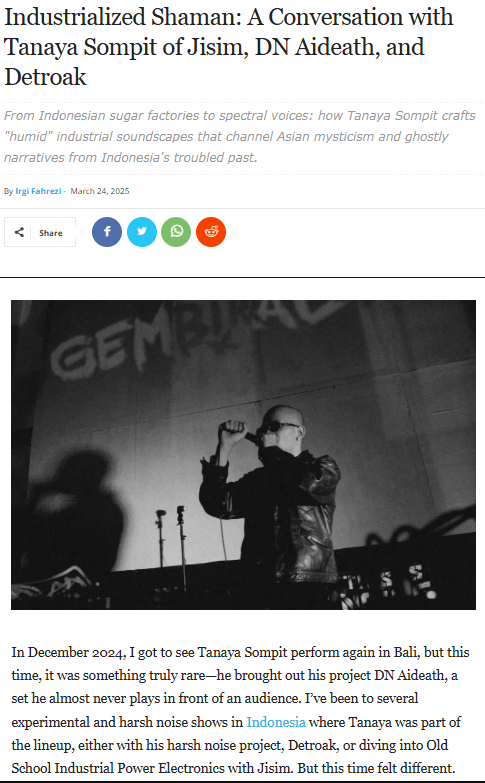
In December 2024, I got to see Tanaya Sompit perform again in Bali, but this time, it was something truly rare—he brought out his project DN Aideath, a set he almost never plays in front of an audience. I’ve been to several experimental and harsh noise shows in Indonesia where Tanaya was part of the lineup, either with his harsh noise project, Detroak, or diving into Old School Industrial Power Electronics with Jisim. But this time felt different.
Beyond the intense performance, I also had the chance to sit down and have a deep conversation with him—talking about his projects, how he shapes chaotic yet structured sounds, and diving into the mystical elements that seem tightly woven into his work. This interview became an opportunity to dig deeper into Tanaya’s thoughts and understand how he approaches his creative process.
Irgi: What got you into industrial music?
Tanaya Sompit: Personally, I’ve always been drawn to this kind of sound. When I was a kid, I loved hearing the noises coming from synthesizers. Then, as a teenager, I spent a lot of time online and discovered a lot of great electronic music—stuff like digital hardcore, industrial rock, and EBM. That eventually led me to noise. Also, I grew up in a rural part of Indonesia, surrounded by sugar factories. At night, the sound of the machines was so loud it reached my bedroom—heavy, mechanical rhythms. Sometimes, I’d play along with my Casio keyboard, just vibing with those industrial sounds.
Irgi: What kind of elements do you try to bring into your projects?
Tanaya Sompit: In Jisim and DN Aideath, there’s a strong horror element. I incorporate mystical Asian narratives, blending them with themes of sadism, rituals, and Indonesian black magic.
Irgi: So, are you talking about rituals and magic specifically from Indonesia or Asia as a whole?
Tanaya Sompit: More towards Asia in general, but musically, I explore across Asia while keeping the concepts and narratives rooted in Indonesia.
Irgi: Do you also draw inspiration from Thailand or Malaysia? Both have strong ritualistic elements that could be interesting to incorporate.
Tanaya Sompit: Yeah, definitely—Malaysia, Thailand, China, even Sumatra.
Irgi: How do you translate Indonesian ritualistic elements into industrial music?
Tanaya Sompit: I focus on the atmosphere—dark and heavy. I also make the sound production feel damp. I think a lot of industrial music from Europe has a dry sound, which makes sense because the climate there is cold and dry. But since I’m from Indonesia, I shape my sound to feel humid—dense, hot, and suffocating, just like the industrial environments and architecture here.
Irgi: How do you capture the essence of rituals and translate that into the audio you produce?
Tanaya Sompit: I focus on the tonal aspects. I work a lot with atonality—there’s no fixed scale or key. But I do create specific tones that can represent a ritualistic feel. I also blend traditional musical cycles with atonal structures, kind of like modifying or customizing my own scale. Hahaha.
Irgi: For most people, it might seem really difficult to integrate tradition or culture into sound production. How do you make it recognizable, even for those who aren’t familiar with ritualism?
Tanaya Sompit: I think tradition already has its own rules, guidelines, and structure, but I’m not directly playing within those traditions. Instead, I create my own set of rules and structures, shaping something new rather than strictly following existing customs.
Irgi: Javanese culture has so many variations. How do you choose which elements or traditions to incorporate into your projects?
Tanaya Sompit: Actually, I don’t take direct samples. I try to be local without being ethnic. If someone asks me whether I’m an ethnic musician or artist, my answer is no. But if they ask whether I’m a local musician or artist, I’d say yes. I don’t package my projects in an ethnic way, and that’s something I apply to Jisim as well.
Irgi: Outside of your own monikers, how do you see the growth of the experimental and noise scene in Indonesia?
Tanaya Sompit: Right now, a lot of friends from different cities are getting into it—not just playing, but also organizing gigs. Many places now have their own experimental or noise communities, which really helps artists. I think it’s great because it means the scene isn’t just centered in big cities anymore.
Irgi: Right now, a lot of people in Indonesia are playing harsh noise. Meanwhile, you’ve started a new project focused on power electronics. How do you introduce this project at gigs that are mostly dominated by harsh noise artists?
Tanaya Sompit: I don’t overthink it when introducing a new project—I know what I’m doing. Some of my friends are already playing this kind of music, like SATO, Grintabachan, and Terminal Liner. Plus, there are other projects like Disharmonis, which has its own unique approach. They’ve performed at noise events that were mostly harsh noise-dominated, and I could feel a different atmosphere in those moments. And honestly, that’s what makes it exciting.
Irgi: Your project DN. Aideath, which recently performed at Chaos Fest, plays in what style?
Tanaya Sompit: I combine death industrial, power electronics, and heavy noise textures, layering them with radio samples and spoken-word narratives about human decadence. I also used this approach on the latest DN. Aideath recording, “Hymne Gorok,” which was released by De/TAINMENT TAPES under Tesco Organisation Germany.
Irgi: The name DN. Aideath seems like a play on DN Aidit, a historical political figure. Did you intend to incorporate something from DN Aidit’s ideology, or does this project have any political background?
Tanaya Sompit: Some people link it to political issues, but honestly, it’s just a wordplay. If you say it in English, it sounds like “The End I Death”, hahaha. I deliberately wrote it to resemble the name DN
Aidit, a well-known communist figure in Indonesia from the Old Order to New Order era. I think people are smart enough to interpret what I mean.
On the first album, I focused on psychological warfare. The material is written from the perspective of ghosts—the souls of victims from the 1965 mass murder. Through these ghostly voices, I retell their experiences—how violence feels, what the atmosphere was like—all through death industrial. I think industrial music is the perfect medium for explicit themes like war, brutality, and even mental struggles.
Irgi: Do you also speak up about the issues from 1965?
Tanaya Sompit: I don’t really dive into political issues. What I do is create horror stories inspired by those dark events. I imagine things from the perspective of the ghosts of mass murder victims— voices that were never heard. And really, who would take a ghost’s words seriously if they had grievances to share? So, in a way, I’m turning these ghosts’ untold stories into the music I make.
Irgi: Since we’re talking about mysticism, does that mean a lot of your projects revolve around it?
Tanaya Sompit: Yeah, because I love it. Another reason is that people need mystery in their lives, and I want to create my own version of horror. But I don’t incorporate mysticism into my harsh noise project, Detroak. Detroak is more about occultism and a fetish for dolls, inspired by the works of Hans Bellmer—a Dadaist artist from Germany in the ’60s or ’70s. He created these eerie doll collages with a fetishistic narrative.
Irgi: So, how much has mysticism influenced you and your musical journey?
Tanaya Sompit: A lot. There are so many layers—like witchcraft, black magic, cultural beliefs, propaganda, social constructs, colonialism—and I’ve explored them all. Not just as fiction, but through a scientific, cultural, historical, and political lens.
Irgi: Do you believe that black magic can operate dynamically as a process?
Tanaya Sompit: It’s possible, hahaha. But I’m not a practitioner—I just love mysterious stories.
Irgi: Can you tell us how you set up your performance when playing DN Aideath, Jisim, and Detroak?
Tanaya Sompit: For Detroak, since I play harsh noise, I use a noise generator along with a few distortion and filter pedals. As for Jisim and DN Aideath, I work with synthesizers, a drum machine, and vocals.
Tanaya Sompit’s Projects:
Detroak – Bandcamp
DN Aideath (Hymne Gorok) – Bandcamp
Instagram – @necrosom
Tahun
Penulis
Bahasa
Penerbit
Tempat Penerbitan
Pranala
Media

 JOGJA SONIC INDEX